From “Jesus Take the Wheel” to “Break Stuff”: country-pop girlies in their alt rock era
Girls these days are embracing rock and rewriting the traditional narrative of the 90s that centers corporate grunge to highlight a more demographically and stylistically diverse modern rock canon. Olivia Rodrigo has singled out The Breeders and The Cure as inspirations and collaborators and revived her own version of Lilith Fair; Charli XCX’s latest album nods to everyone from Lou Reed to James Murphy to Kim Gordon; Chappell Roan has called on the likes of Kate Bush and KMFDM; and on the indie side of things bands like Lime Garden and Avalon Emerson and the Charm have put out some very baggy-beat influenced music in the last year. In part this is just the next “new wave” in what Theo Cateforis has identified as rock’s modernist embrace of long-past styles in order to indicate a break with the present mainstream. Just as The Ramones looked to simpler 50s blues styles to stand out amid 70s prog and glam, today’s rock artists look to the 90s and early 2000s to create a distinctive voice in a pop space that has largely abandoned rock altogether.
With her peers intentionally overlooking the corporate grunge narrative built by the Alternative Airplay charts of the late 90s and early 2000s, it’s especially interesting that Carrie Underwood has directly embraced it. As Rolling Stone reports,
The article also notes that other headliners of Velocity Festival included Lynyrd Skynyrd and Creed; each of these bands is notable for songs about white racial backlash (“Sweet Home Alabama” and “One” respectively), and earlier this year far right influencers explicitly took up Creed as a proposed alternative to Super Bowl halftime show headliner Bad Bunny.
Though the Rolling Stone article situates these choices of cover songs alongside Underwood’s earlier collaborations with rock artists like Motley Crue, her choice of “Break Stuff” suggests that she’s signaling more narrowly around millennial alt rock in particular. As the 2022 Netflix documentary Trainwreck shows, Durst’s performance of “Break Stuff” at Lollapalooza 99 was the direct catalyst for the riots that many have compared to the January 6, 2021 far-right insurrection. In an earlier post, I noted:
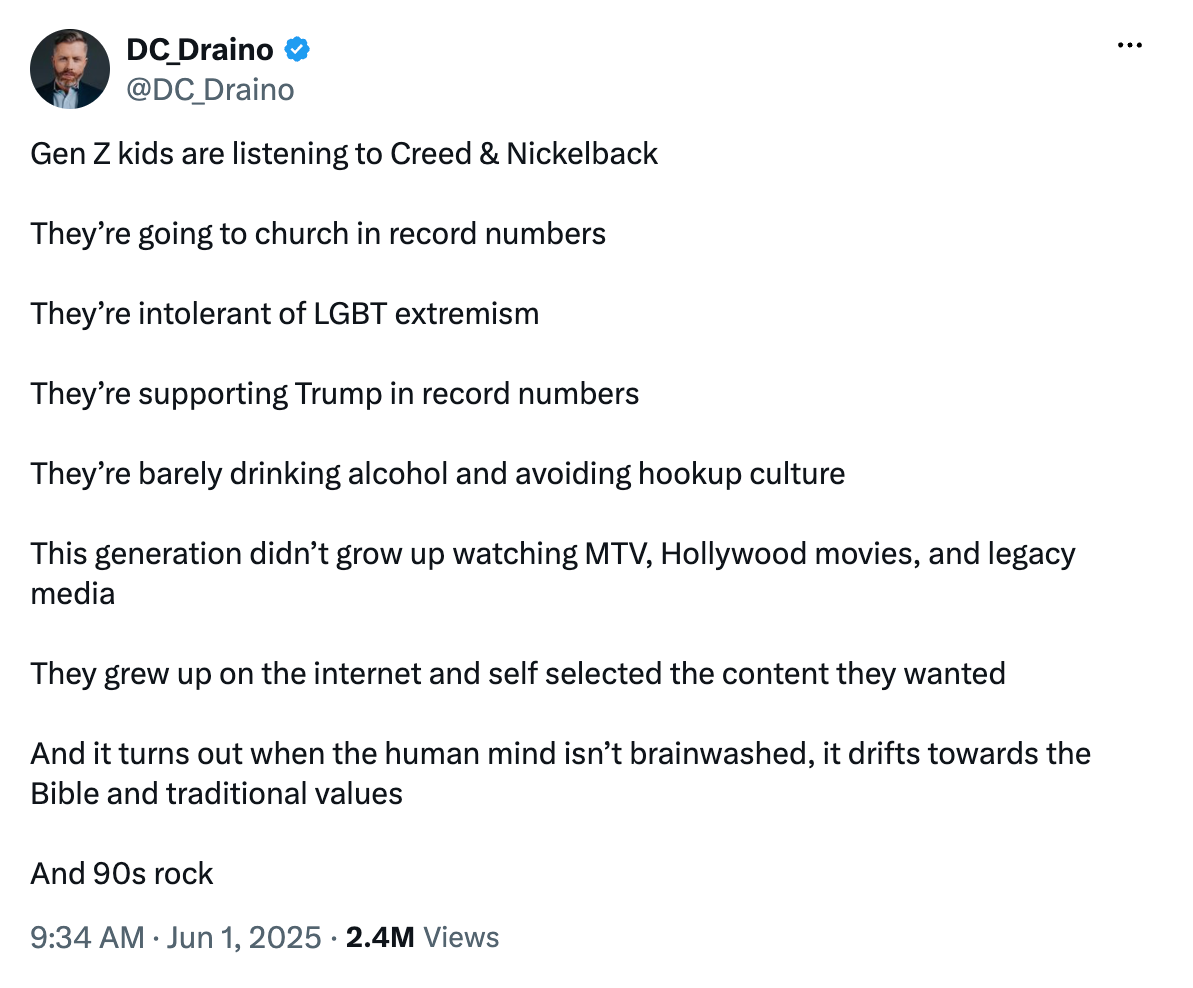
Fueled by primarily misogynist grievance, this episode at Lolla 99 is aligned with the contemporary far right’s general strategy of misogynist grievance. Numerous studies have shown that one thing that defines the so-called “alt right” compared to other forms of white supremacist extremism is its centrality of misogyny and anti-feminism. Such misogyny was also the bread and butter of millennial alt rock radio. As Lauren Goodlad observed in a 2003 chapter, alt rock DJs like Tom Leykis “feature[d] a telephone format in which male callers vent their anger at women and inveigh against the alleged rule of political correctness.” Contemporary far-right influencers like X user @DC_Drano connect millennial corporate grunge to their movement, and that’s easy to do because they both foreground misogynist grievance.
If 90s corporate grunge acts like Creed and Limp Bizkit read as far-right, it’s interesting that Ms. “Jesus Take the Wheel” is leaning into this part of the rock universe for her rock era. Underwood won American Idol in 2005, just two years after The Chicks got excommunicated from Nashville for criticizing George W. Bush’s approach to the wars in Iraq and Afghanistan, and three years after Toby Keith released “Courtesy of the Red, White, and Blue (The Angry American).” Back then, country signaled conservatism and “murica’”-style kitschy white patriotism, and due to a decades-long collaboration between the country music industry and the Department of Defense, country was stereotypically associated with conservatives, especially after the 1984 success of Lee Greenwood’s “God Bless the USA.” Underwood’s country leanings set her apart from the rock and R&B of previous Idol winners Kelly Clarkson, Ruben Studdard, and Fantasia Barrino, and it’s even possible to read Underwood’s win as white backlash against the success of a very talented Barrino. 20 years ago, Underwood’s country leanings aligned her with the stereotypical “Ohio diner” patron: white, rural-ish or at least flyover country, generally conservative.
But fast forward to 2026 and country is the sound not of conservatism, but the reactionary center. This summer, the Billboard Hot 100 has been dominated by formulaic, slop-y, Spotify-core country tracks like Ella Langley’s “Choosin Texas.” That song in particular uses lightly country vibes to cross over from country to pop to adult contemporary radio formats and thus amass the numbers needed to dominate the charts. This sort of lite country reads as “both-sides”-y as The New York Times or The Atlantic.
In this context where country-pop gives reactionary centrist vibes, Underwood would need to change her tune to stay aligned with her generally conservative listener base. It makes sense that she would follow fellow white country-pop superstar Taylor Swift into an alt-rock era; as I discuss at length in the forthcoming second edition of Resilience & Melancholy, “Actually Romantic’s” interpolation of The Pixies “Where Is My Mind?”, which soundtracks the closing scene of the movie that coined the term “snowflake,” aligns her with the contemporary alt-right and its politics of grievance. In some ways, we are back to the politics of the Disco Demolition era, where white cishet rock fans doubled down on a politics of genre and identity purity while post-punk disidentified with that mainstream by looking to disco and reggae for inspiration. Except nowadays, because musical and just about every other sort of humanistic cultural labor is unsustainably low-waged if it pays at all to the point that it has become another type of feminized reproductive labor, this battle is fought by and among women artists and fans.