Devo and the possibility of dada in the era of personalized media
In mid-October 2025 author and journalist Talia Lavin argued “we should bring dadaism back as a response to The Horrors. It made sense during world war one.”
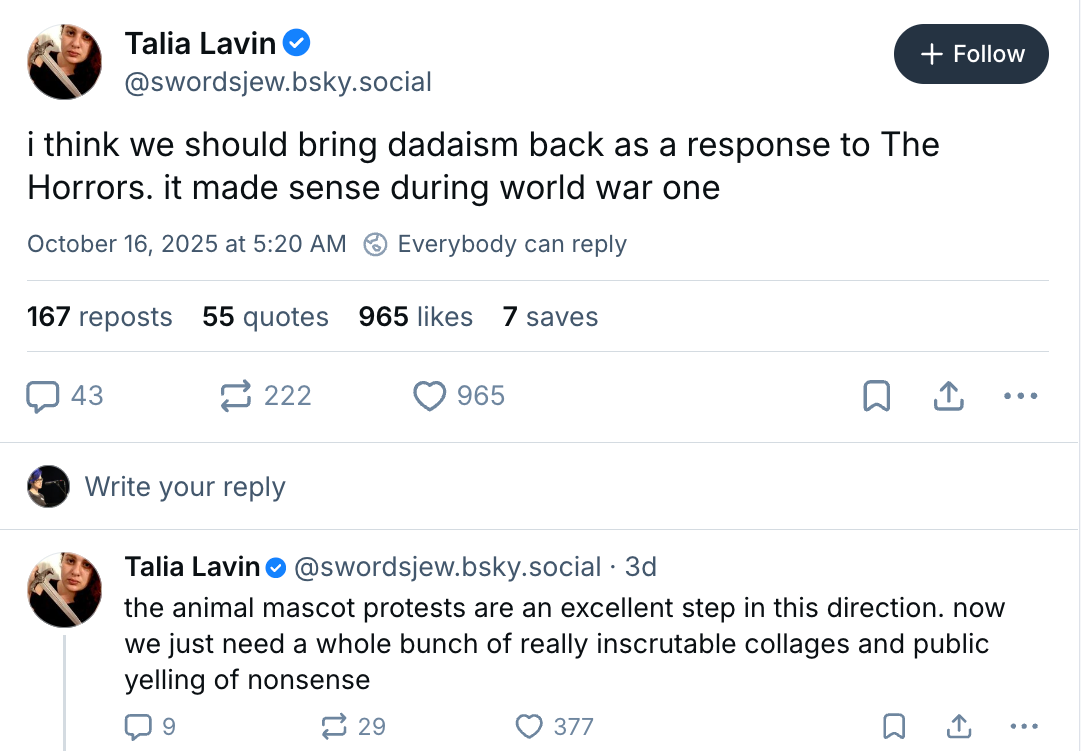
In its original context, Dada used artistic expressions of nonsense to show how the violence of WWI transgressed the norms and boundaries of shared consensus reality so spectacularly as to render them meaningless. For example, nonsense prose is a way to artistically represent literally unspeakable violence; it invokes a formerly shared reality as something that has been illegitimately transgressed or destroyed by state violence.
Though Lavin locates Dada as something that happened over a century ago and has yet to have a revival, there’s a much more recent and local example USians can look to as we figure out how to respond to the secret police disappearing people and National Guard troops deployed across blue cities: the new wave band Devo.
Formed in Akron, Ohio in the late 1970s, Devo was a direct response to Mark Mothersbaugh and Gerald Casale’s presence at the May 4, 1970 shootings at Kent State University. Netflix’s new Devo documentary covers this in detail, but the band has been very outspoken about this for a long time. Twenty years ago, Casale gave an interview to the Vermont Review where he said:
“Devolution” is the philosophy Casale and Mothersbaugh developed using their art backgrounds to take a lefty and avant-garde riff on fin-de-siecle anti-Darwinism. A kind of Adorno-and-Horkheimer-inspired take on the otherwise conservative idea that the trappings of modern life create degeneracy in society, “the band’s devolutionist philosophy claims that the world is in a downward spiral of decadence, fuelled by moral decline, mechanisation, and overconsumption. Ultimately, mankind will dictate its own demise or devolution.” Parodying things like bourgeois white masculinity, postwar American media, and the like, Devo pointed out the absurdity and repressiveness of mainstream American popular culture. A state that would send in the military to shoot its own unarmed citizens for exercising their First Amendment rights is certainly a devolved one – the fact that these students were all white and at least well on their way to the middle class makes that devolution appear even more strong, as these students come from classes typically subject to both the law’s obligations and its protections.
Devo explicitly connected their playful devolutionary aesthetic to Dada. As Casale tells Simon Reynolds in Rip It Up and Start Again,
After Kent, it seemed like you could either join a guerrilla group like the WeatherUnderground, actually try assassinating some of those evil people – the way THEY had murdered anybody in the sixties who’d tried to make a difference–or you could just make some kind of wacked-out creative Dada art response. Which is what Devo did (76-7).
Casale’s framing of Dada as “wacked-out” points to one key feature that Devo shares with its 20th century precursors: the reference to a prior consensus norm or reality that can then be spectacularly transgressed.
This shared sense of a common reality is being directly attacked by today’s media environment, where recommendation algorithms and AI deliver “personalized” content tailored to each individual’s niche tastes. The technical term for this is a “filter bubble,” which the BBC defines as “a space where our previous online behaviour (search history, likes, shares and shopping habits) influences what we see online and on our social media feeds and in what order.” There are many academic studies about the connection between algorithmic personalization, filter bubbles, and political polarization.
Algorithmic personalization amplifies a much older epistemic problem, one which pre-dates computers and even mass media. Philosopher Charles Mills calls this problem an “epistemology of ignorance”. Systemic oppression and power differentials lead so-called “consensus reality” to be modeled on the experiential reality of society’s most privileged and powerful group(s): their conseusus gets overgeneralized as everyone’s. Mills uses the language of “virtual reality” to describe how white people inhabit a world structured by white supremacy: they “live in an invented delusional world, a racial fantasyland, a ‘consensual hallucination,’ to quote William Gibson’s famous characterization of cyberspace, though this particular hallucination is located in real space” (The Racial Contract, 18). White supremacy organizes white people’s epistemic field such that their mistaken consensus (e.g., that racism is over, that colorblindness creates equity, etc.) counts as “reality” as such. For nearly all of its 300-ish year history, liberal consensus reality has been a white supremacist “consensual hallucination” naturalizing whiteness and white privilege.
It’s precisely that white consensual reality Devo targets. As Theo Cateforis has argued, new wave performers such as Devo used the figure of “nervousness,” traditionally associated with white people and white identity as
a space within which they could both celebrate and critique their cultural backgrounds, and also present a version of whiteness quite different from what had come to typify the societal norms of the 1970s…the appearance of new wave’s nervous front man in the late 1970s offered nothing less than an alternative masculinity, one whose greatest power derived from the ways it diverged from or contradicted what had become rock’s normative performative stance” (Are We Not New Wave? 80-82)
Devo’s nerdy nervousness was a critique of cock-rock style sexuality, which involved the white appropriation of stereotypical Black masculinity. Think of their cover of The Rolling Stones’ “Satisfaction”: it’s all stilted and jerky, not frustrated and horny like the original. In this way, they drew attention to the normative assumptions behind rock star stereotypes of the day.
If Devo was attacking some common shared stereotypes and assumptions for their complicity in the hegemonic and devolutionist American culture, their project is vastly different than the one we face today in 2025. Their target was a mass-mediated white consensus reality; in the era of streaming, algorithmic personalization, filter bubbles, library and public school defunding, and the like, our task is instead to figure out how to build alternative ways of being and knowing in common.
And this time we can improve on old liberal bourgeois consensus reality. The task is to convince people that we depend on one another – that’s the actual reality that we need to get everyone to concede. The only way we can exist is if we do so together, in society. Existential phenomenology holds that the fact of human interdependence is the only “reality” not shaped by human cultural intervention; this is the point of Beauvoir’s Ethics of Ambiguity, if you want to read about this in more detail. Every aspect of human existence beyond this fact is up for grabs, and existing is the ongoing process of (re)negotiating that grab.
In addition to being just about the very minimum you need to get people to agree on to create a shared sense of reality, the idea that we all depend on one another is precisely the idea that everyone from AI boosters to manosphere influencers to tech platforms to most people in position of power in the US Federal Government are trying to destroy in order to better control and extract money from us.
I don’t think dada-esque nonsense is the thing we need in this specific moment. And the work that the arts can do to help create this minimum sense of shared reality is probably less representational and more practical. No matter what art says or depicts, the meaning it creates unfolds as people share experience of making and receiving it together: a band debates how a song should go, friends at a concert discuss whether the cover in the encore was better than the original, academics give papers at conferences about a painting’s use of color, and so on. Similarly, art only happens when people come together to make and distribute it. Participating in the arts ecosystem we can practice the kinds of interdependence that constitute the fundamental fact of human society. To make, share, and receive art is to participate in society. (Certainly this has been done in more and less equitable ways, but that’s again the whole issue of the continual renegotiation of the underlying fact of interdependence.) Exercising what Anna Kornbluh and Ignacio M. Sánchez Prado call our “right to culture” may be one of the most expedient and low-overhead/buy-in ways to start convincing people that we do in fact live in society. And although there are certainly forms of “bad faith” culture that denies our interdependence and sociality (think about that Nazi group chat recently uncovered by Politico, or if you know Beauvoir’s Ethics of Ambiguity, think of all those personas in chapter 2 who live in bad faith (the child, the nihilist, the adventurer, the serious man)), apart from that it really doesn’t matter WHAT the content of the culture you participate in is: maybe you have a group of friends with monthly progressive dinners, maybe you are in a band, maybe you have a weekly role-playing game session, whatever. Exercising our right to culture is an onramp to the more profound realization that we exist together in society, that fact is inescapable, and we shouldn’t be fooled into thinking otherwise.