Shannon Winnubst gave a great paper this past Friday at SPEP. I want to talk about and expand on it here because I take Winnubst and I to be pointing in the same direction, at similar phenomena, but from different…
I teach a lot of texts that presume, use, build on, or critique Foucault’s concepts of juridical, disciplinary, and biopolitical power. So, instead of taking up class time re-hashing the same lecture, I decided to make a video podcast that…
Today is Ada Lovelace Day. In honor of the first person to write what would later be known as a “computer program,” I want to think about women and music technology. Many readers of this blog probably already know who…
Feminist musicology as we know it is only 20 years old. Susan McClary’s landmark book Feminine Endings: Music, Gender, and Sexuality was released in 1991—the same year that Nirvana broke on pop radio. While the latter release is being widely…
This post is a very, very initial attempt to sketch a theory of “transmission.” I develop this idea of transmission in conversation with Jasbir Puar, Joy Division, and Bauhaus. Transmission is an sound-based concept, an attempt to theorize from “the…
Consistent readers of this blog know that I’ve been somewhat interested in the politics of melisma in contemporary pop music. I have a piece on Avril Levigne’s use of melisma to signify both “blackness” and sexual availability you can read…
This post is significantly revised from the 30 August version. After Lady Gaga’s drag king performance at the 2011 MTV VMAs, many people are talking about the gender politics of her performance, its queerness (or not), and especially Britney Spears’…
Much is often made of the queerness of the (Dr) Who-niverse’s Captain Jack Harkness. Sure, he’s played by an openly gay actor, been in same-sex and inter-species relationships, and in the new Starz/BBC collaboration the character is allowed to have…
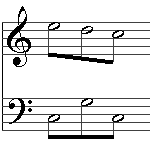
“Rhythm” and “Harmony” are often offered as contrasting, if not opposed, ways of organizing pieces of music. As the famous diagram attests, Western music uses harmony (chords) as its way of organizing pieces of music: all you need to start…
As you know, I’ve been thinking—not primarily, but sort of in the background—about how we subvert or resist Foucaultian “biopower.” I’m not talking about the “disciplinary” aspect—I think Butler gives us a good account of how to subvert discipline (i.e.,…
Recent Comments